
For more posts about art and inspiring moments click HERE
The Float Between The Structures
It was hotter than hell. Their feet burned as they kicked through the sand. Sweat dripped and their sunglasses slipped to the tips of their noses. The coolers were heavy but necessary; when the temperature exceeded 105 degrees they would be rewarded for their extra efforts. When they reached the river's edge they loaded their rafts. They left behind the lurid architecture and floated without motor or sail along the currents that carved about rocky cliffs and muddy banks.
Always moving yet going nowhere, atop the cold water, beneath the boiling sun, they found refuge in their intermission, taking no lead in their direction, allowing the world to pass at its discretion.

24" x 19", oil pastel, acrylic, and colored pencil on paper, 2015
They met a dolphin wallowing in the river and fed it cherries and sangria. It laughed and splashed them. They joined it in the channel, cooling their heads and washing their bodies of the grease marks from the machines. They found moments of clarity in the clear water, or upon their bubbles of air among the nameless lulling waves, floating like wise spirits on soft clouds to the inevitable structure at the end of the respite.
(For more info about the Intermission paintings, click HERE.)

Flying Ants And The Precipice Of Uncertainty, 46" x 36", oil, acrylic, ink, canvas, 2015.
Flying Ants And The Precipice Of Uncertainty
In the sunny afternoon, people strolled the dirt paths in the park eating popsicles. Others were laying in the grass. Over the hill someone played a saxophone, and nearby, a young guy practiced juggling bowling pins.
Beyond the clowns doing cartwheels at the end of the parade, the city had a dark side to it. The buildings were graffitied not with an aesthetic effect, but to that of territories marked. Peddlers of worthless junk were more abundant than buyers. I saw a convoy of five or six armored vans pass me on the walkway as the sun was setting.
I saw a guy in the distance light a firecracker. I had not been paying attention to him -- in the coming darkness, he was nothing but a shadow under the street lamp at the park gate about a hundred yards away. But the sudden explosion stung my ears and rattled my nerves. An M1000 or the like. A few minutes later, as I was crossing the humming intersection and had wholly forgotten about him, another explosion shivered my skin.
Hours later, I leaped out of sleep to the detonation of another one. It could not have been more than fifty yards from the pale morning glow of my bedroom window. I only knew it was not a real bomb because people were not running from a cloud. Had I dreamt it? What a horrible dream that would be, to be wakened by a shaking blast fabricated solely within the skull.
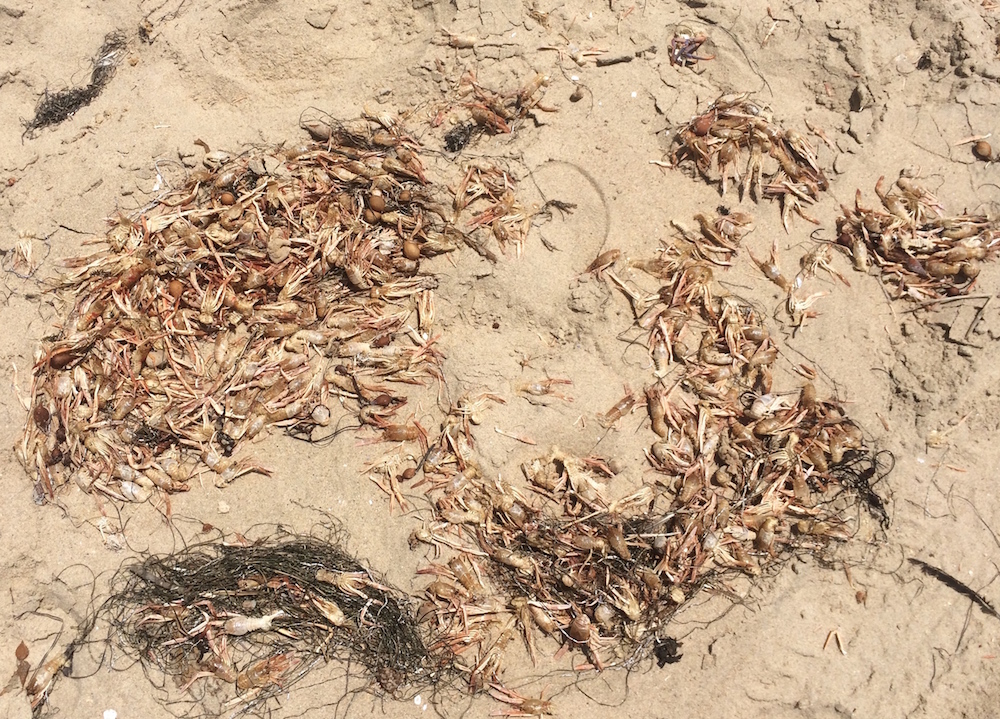
Upon my return to southern California, when I descended and walked the beach, I found thousands of shrimp-like crustaceans dead in the sand. Swarms of flies hovered low and knocked against my shins. Fat seagulls watched me with lazy eyes. As the waters had warmed, the so-called Tuna Crabs had arrived from the far south for the first time in over a decade, and their mass deaths seem to be a mystery. It reminded me of news from two years ago, when millions of krill washed ashore Oregon and Washington, their largest recorded die-off in the region.
I stood on the cliffs along the coast gazing over the precipice at the hazy horizon, wondering what would next appear from under the gray blanket.
To see more posts about art and inspiring moments, click HERE
Heavy Hooves in Spain
Yesterday I saw a man on the street sitting on the sidewalk with his back up against the building, his legs stretched out ahead of him, his pants rolled up mid-shin exposing where both feet had been amputated. His legs were dirty and red and it was sad. Later I saw him, his pants rolled down and around something like hooves that he was walking on. Poor guy had fucking hooves.
Speaking of hooves, I went to a bullfight in Madrid. I had been viewing dozens of paintings by Spanish artists, and I figured I should experience Spanish culture to have a better understanding why Picasso often used bullfighting subjects in his art.
The event includes six bulls and three matadors who each kill two. The bulls are huge, weighing around 1,000 pounds. The matador struts around with his bright cape and skin-tight uniform with intricate sparkling decorations, he and his toreros all wearing bright pink socks.
The infuriated bull races out of a tunnel into the dirt ring where the matador and his toreros await with capes. But the first wound to the bull comes not from the matador, but from the picador, a guy holding a lance atop a huge blindfolded horse outfitted with sheets of heavy padding on each side. At this moment the bull is strongest, it charges the horse’s side with all its force, and the impact is heard throughout the arena. The horse, blindfolded, cannot anticipate the collision, and it stumbles and gets lifted off its legs but somehow withstands it (although one time the bull collapsed the horse and rider, and there was a diversion of the bull’s attention as others scrambled to get the horse up). The picador drives his lance down into the bull like a spike, and he leans on it with his weight to hold his balance as the bull thrashes against the horse, blood gushing up and over the bull's shoulders.

After The Picador, 19" x 24", acrylic and colored pencil on paper, 2015.
We hear the heavy hooves and can sense the immensity of the beasts. Then some more waving and dodging with the bright capes, the bull charging one torero and another, until the matador struts around with short barbed sticks in each hand, holding them up like a praying mantis. The angry bull sometimes sniffs and digs in the dirt before charging, and when the charge comes, the matador dances to the side and stabs the sticks into the shoulders. At this point the bull’s mouth froths and its tongue dangles, urine drips from its cock and its belly heaves for oxygen. Blood has caked in various places around the ring, and it continues to erupt from the bull’s wounds. Some more caping and dodging by the toreros as the matador takes a breather, wipes his face, retrieves the red cape and a sword. He returns to do more specialized and stylized caping, arching his back and holding his posture, offering the cape, shuffling his feet ahead, teasing and yelping to summon the exhausted bull forward. The bull stumbles often or gets its horn planted in the dirt. But it always gets up to fight on. What kind of passion, its desire to fight, to live!
Finally, the matador holds the sword up and looks down the blade, like a gunner at his target, and at the opportune time he plunges it between the shoulders and down just behind the neck, trying to bury the blade completely, succeeding sometimes, and turns to the crowd with his strut indicating time for applause. And the people cheer as the toreros wave capes from either side of the bull’s vision as it stands there confused and weak in the last seconds of its life, turning its horns one side to the other at the flashing capes, until finally, as blood drips to the dirt like mountain water over a mossy rock, the bull collapses.
The people cheer some more as the matador continues strutting. A team of horses arrives from out of a tunnel, trots up to the corpse, gets it hooked up, and drags it through the dirt in a semicircle around and out through the exit gate, leaving a large dust cloud over the snaking slide mark. The poor beast dragged off like some debris from a fallen building.
Appear some workers to rake the dirt and shovel off the caked blood. Another worker marches to the center of the ring with a sign displaying the name of the next bull. And the next killing begins.
(From Las Ventas, Madrid, Wednesday, May 20, 2015.)